The Ori Robotics team
Google does not build robots. It builds the harder part: the brain. On Tuesday, Google DeepMind announced Gemini Robotics 2.5, the newest version of that brain, and this time the demo was not a lab table. It was a Mercedes-Benz production line.
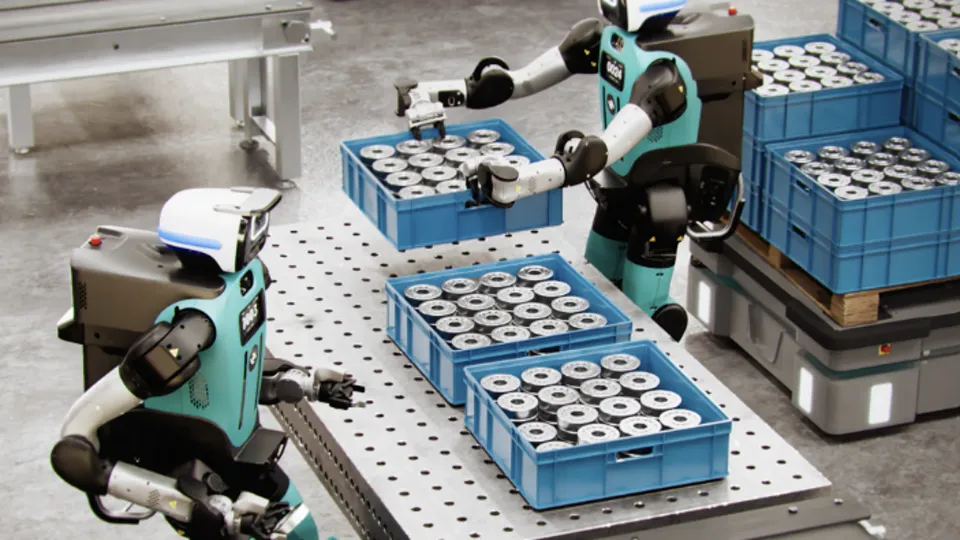
Running inside Apptronik's Apollo 2 humanoid, the AI picked metal brackets out of supply bins and packed them into the trays that follow each car down the line. It did this on active lines in Sindelfingen, Germany and Kecskemét, Hungary. DeepMind reports a 96% success rate.
The robot got a real job review
Robot demos usually happen in rooms built for robots. This was the opposite: live production, real parts, and a parts list that changes with every car coming down the line.
DeepMind calls it a proof of concept, which is the honest label. Nobody has published how many picks were attempted, and a proof of concept is an exam, not a job offer. But the exam clearly went well. "This is what we built Apollo for: useful work alongside people in real industrial settings," said Jeff Cardenas, Apptronik's chief executive. He says the models improved dramatically within "just a few weeks of post-training", and carried over to the Mercedes lines with "very little drop-off".
96%
Success rate DeepMind reports for Apollo 2 picking and packing automotive parts on live Mercedes-Benz lines, in its own proof of concept.
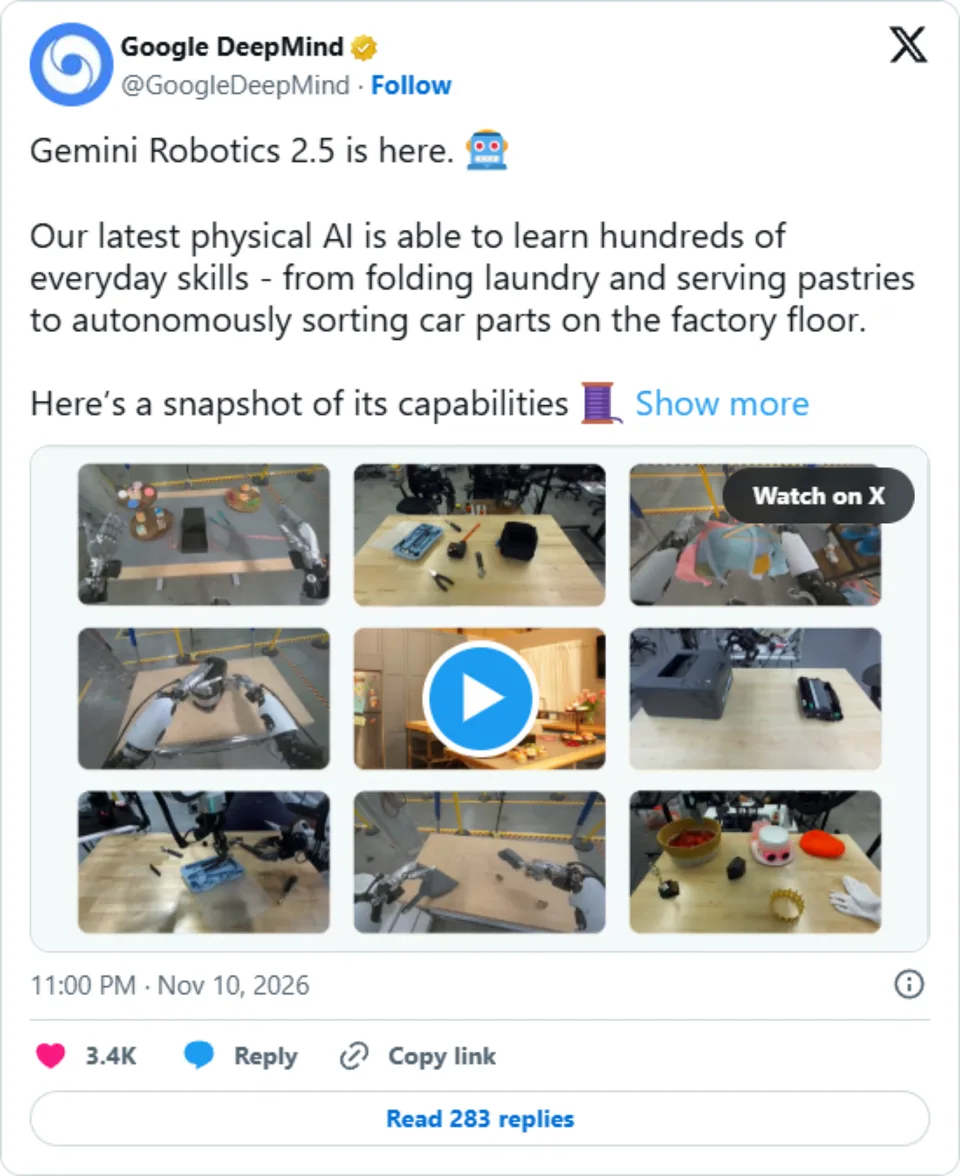
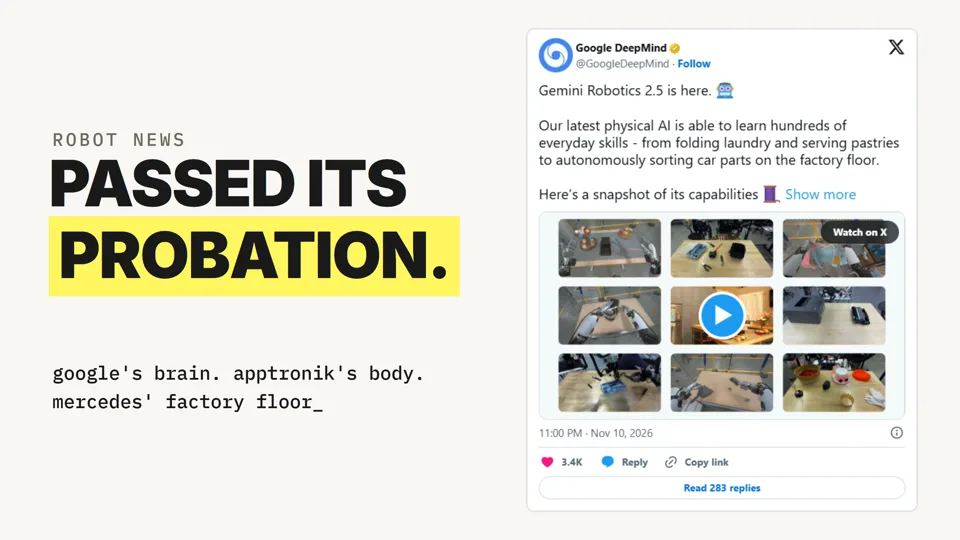
DeepMind's announcement, with the capability reel. Via X, tap to watch.
The Android playbook, for robots
The most important part of this story is who did what. Google supplied the AI. Apptronik, a Texas company that grew out of a university robotics lab and helped NASA build a humanoid, supplied the body. Mercedes supplied the factory, and happens to be an investor in Apptronik. So does Google.
That is the Android playbook. Google does not make your phone either; it makes the software inside most of the world's phones. DeepMind says Gemini Robotics 2.5 is now rolling out to its robotics partners, and its research partner list reads Apptronik, Agile Robots and Boston Dynamics. One brain, many bodies.
The brain itself is what researchers call a vision-language-action model: camera images and plain instructions go in, arm and hand movements come out. At Mercedes it worked as a pair, one model tracking the workflow while the other controlled the hands. If that loop sounds familiar, it is the sense-decide-act cycle from our plain-English guide to physical AI, now holding down shifts at a car plant.
What 96% actually means
96 sounds like an A. On a production line it means one miss in every 25 picks, and a line does thousands of picks a shift. That is why the robots work alongside people rather than instead of them, and why German tech press reporting put the Apollo count at the Mercedes plants at fewer than ten robots as of last year. You pilot small, and you count everything.
The more telling numbers are the boring ones. DeepMind tested the model across 200 different tasks and says it succeeds 30 to 100% more often than its predecessor, while moving 20 to 30% faster. Robot bodies improve at hardware speed, slowly and expensively. Robot brains are now improving at software speed. That gap is the whole bet behind physical AI.
Why this is closer than it looks
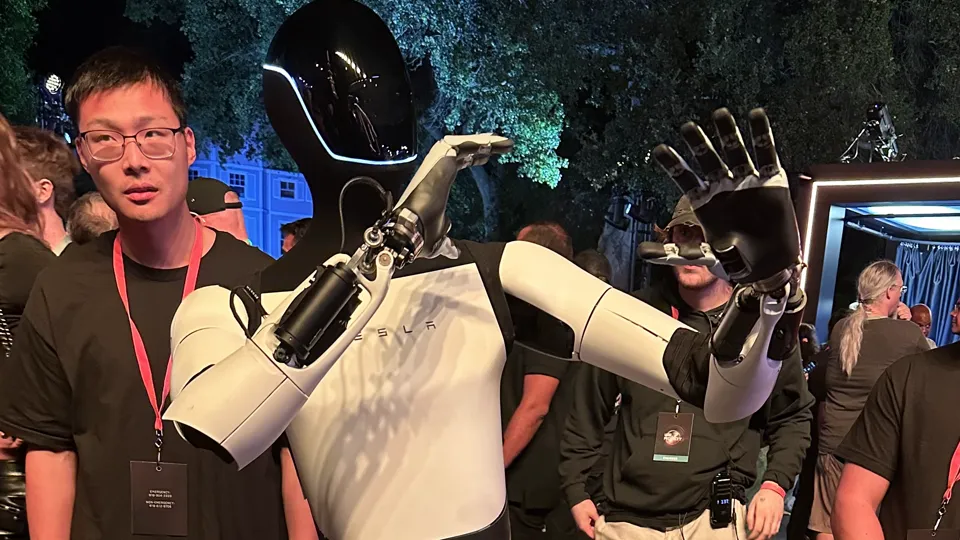
A humanoid packing brackets in Hungary can feel far from daily life in Singapore. It is not. Tesla is betting everything on building both the brain and the body itself. Google just showed the opposite model working: let specialists build the bodies, and sell every one of them the same ever-improving mind.
If the phone era is any guide, one of these playbooks ends up everywhere, in warehouses, hospitals and void decks. The people who understand how these machines sense, decide and act will be the ones everyone else calls when the robots show up. The robots, evidently, have started showing up.
Quick answers
What is Gemini Robotics 2.5?
Google DeepMind's latest vision-language-action model: an AI that takes in camera images and plain instructions and outputs robot movements. It is the brain Google supplies to robot makers such as Apptronik.
What did the robot do at Mercedes-Benz?
Apptronik's Apollo 2 humanoid, running Gemini Robotics 2.5, picked metal brackets from supply bins and packed them into per-vehicle trays on live lines in Sindelfingen, Germany and Kecskemét, Hungary, with a 96% success rate in DeepMind's proof of concept.
Does Google build its own robots?
No. Google DeepMind supplies the AI brain to partner companies, including Apptronik, Agile Robots and Boston Dynamics, much as Android powers phones Google does not manufacture.