The Ori Robotics team
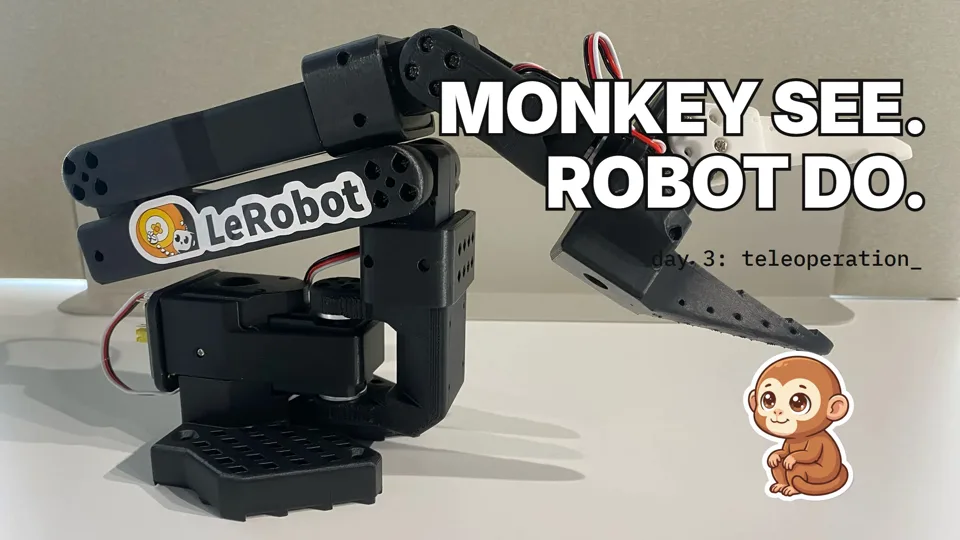
Day 3. Last time I promised that this week I move my hand and the robot copies me. What I did not appreciate until I tried it: this little mirror game is quietly how modern robots learn almost everything.
It turns out the $122 arm from day 2 is half of a set. The SO-ARM 101 is really two arms, a leader and a follower, about $230 in parts for the pair plus the bits you 3D-print. I spent the week holding one of them and being copied by the other.
The puppet and the puppeteer
The leader arm is the same six-motor skeleton as the follower, with two changes. Its gripper is swapped for a printed handle with a trigger, so you hold it like a joystick. And its motors are geared differently, so the arm carries its own weight but swings freely when you push it. It is built to be moved.
The follower's whole job is to mirror. Software reads the leader's six joint angles and commands the follower to match, about 30 times a second. I lift, it lifts. I squeeze the trigger, its gripper closes. There is no AI anywhere in that loop. It is a photocopier for movement, and it is completely mesmerising.
Wait, where did the hard maths go
Day 2 was me being humbled by inverse kinematics, the puzzle of turning "gripper there" into six motor angles. In the mirror game, that puzzle simply vanishes. I am the computer now. My brain solves every reach the way it always has, without showing the working, and the robot just steals the answers.
That is the honest definition of teleoperation: borrowing a human body's intelligence, one motion at a time. For decades it was how robots defused bombs and fixed things underwater. The new part is what happens to the motions afterwards.
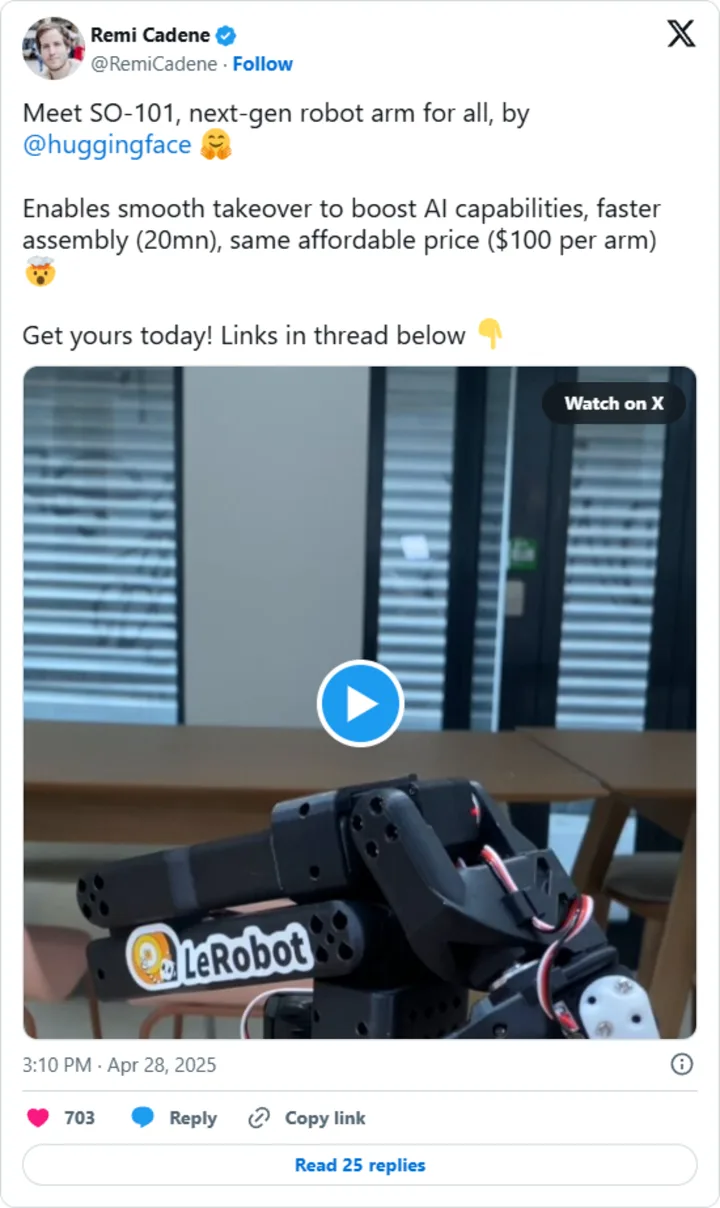
The SO-101 launch post from LeRobot's creator. Via X, tap to watch the takeover.
The mirror game is secretly a classroom
Here is the twist that makes this bigger than puppetry. While I steer the follower through a task, the software records everything: every joint angle, every camera frame, the whole motion, saved as one "episode".
The standard recipe in LeRobot, Hugging Face's open robot learning library, is to record about 50 episodes of one task. Their tutorial example is picking up a Lego block and dropping it in a bin. Then a neural network trains on those recordings for a few hours, and the follower tries the task with nobody holding the leader. The field calls it imitation learning, which for once is a perfectly honest name.
50
Demonstrations the LeRobot tutorial recommends recording to teach the arm one task, before it tries the task alone (Hugging Face documentation).
From $20,000 to console money
None of this recipe is new. In 2023, Stanford researchers built ALOHA, a pair of puppeteering arm rigs on a $20,000 budget, and their code named the two sides "master" and "puppet". The training method they introduced is still the default one LeRobot hands you today.
What changed is the price of admission. Three years from a $20,000 research rig to a $230 pair of arms you print yourself. The library has 28,000 GitHub stars and the Hub hosts thousands of shared recording datasets, which means thousands of kitchen tables are now doing what only labs could do when I started paying attention.
Why everyone suddenly wants your hands
Every smooth "robot folds the laundry" clip you have seen stands on a pile of episodes like mine, recorded by a person moving the robot or a twin of it. The frontier labs run the same see-then-do loop, just with fancier rigs and far more hands. It is the same loop from our physical AI guide, with a human temporarily standing in for the "decide" part, and it is the loop worth learning first if any of this is going to be your world.
That is day 3. My wrist is tired and the follower now has 50 recordings of me picking up a block. Next time: I stop touching the robot entirely. We train on those recordings and find out what, exactly, it learned. I am both excited and braced.
Quick answers
What is teleoperation in robotics?
Driving a robot's movements directly with your own, through a device such as a leader arm whose joint positions the robot mirrors in real time. In robot learning it doubles as the way to record demonstrations.
What is a leader-follower robot arm?
A matched pair of arms. You move the freely geared leader by hand, and software commands the follower to copy its joint positions, about 30 times a second on the SO-ARM 101.
How many demonstrations does a robot need to learn a task?
The LeRobot tutorial recommends recording about 50 episodes of a task, spread across locations, then training for a few hours before the arm attempts the task on its own.