The Ori Robotics team
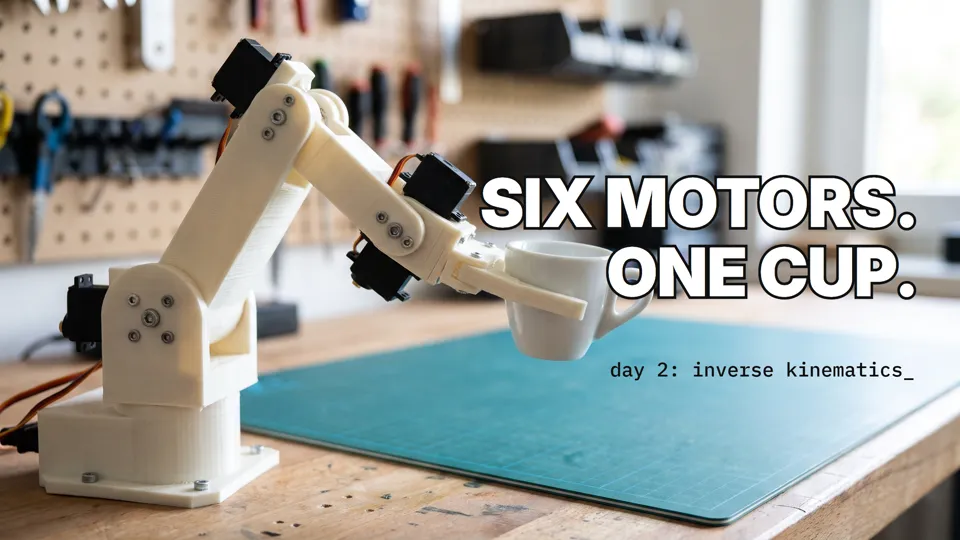
Day 2. This morning you solved an inverse kinematics problem reaching for your coffee. You just never saw the working.
To actually see the working, I got an SO-ARM 101: a small open-source robot arm you 3D-print and bolt to a desk. It is about $120 in parts, it is held together with hobby servos and optimism, and it sounds like a nervous sewing machine. I love it.
What is the difference between forward and inverse kinematics?
Kinematics is the geometry of bodies: joints, segments, and where everything ends up. It runs in two directions, and the difference between them is the whole story.
Forward kinematics is the easy direction. If every joint is bent like so, where did the fingertip end up? You can answer it with a chain of "this piece, then that piece". One set of angles, one answer, no drama.
Inverse kinematics is the direction life actually runs in. I want the gripper there, on the cup. What should every joint do? Every useful thing a robot ever does passes through that question, and it is much, much harder.
Why is inverse kinematics hard?
Forwards has one answer. Backwards has many, or none. Touch your nose right now: elbow high or elbow low, both correct. Your body picked one without consulting you.
A robot has to pick on purpose, every time. And for some targets there is no answer at all, because the cup sits two centimetres past everything the arm can physically do. The arm needs to know that before it lunges, not after. Mine established this by slapping the cup off the desk. Twice. Research.
6
Servo motors in the SO-ARM 101. Every reach needs six correct answers, delivered together (TheRobotStudio and Hugging Face parts list).
Every task is secretly a reach
"Pick up the cup" is "put the gripper around that cylinder, then close". "Open the door" is "put the gripper on the handle, then pull it along a curve". Strip away the language and nearly everything a robot does ends in the same sentence: put this part of me exactly there.
That is why kinematics is the plumbing of getting things done. The flashy AI decides what to do. The sensors from day 1 say what the world looks like. Kinematics is how anything physically happens, and it is the maths our course is built around.
The hand is the hard part
Getting the arm to the cup turns out to be the easy half. Then the hand has to hold the cup without redesigning it. My robot's hand is two plastic fingers driven by one motor, which turns gripping into a single yes-or-no question.
Your hand, meanwhile, has more moving parts than my entire robot, plus pressure sensing in every fingertip. Holding without crushing and feeling without looking are whole research fields right now. The two plastic fingers and I are starting with espresso cups and staying humble.
The part your body hides from you
Your arm has more joints than any single reach needs, and your brain quietly spends the surplus: keeping your elbow off the table, saving effort, keeping the coffee level. You get all of that for free, every waking second.
A $120 arm gets nothing for free. Every choice has to be made explicit, in numbers, many times a second. Which is turning out to be the recurring lesson of this series: everything you do without thinking is an engineering problem wearing a trench coat.
That is day 2. The arm and I are still negotiating. Next week: I move my hand, and the robot copies me. Teleoperation, and why it is secretly how robots learn.
Quick answers
What is inverse kinematics in simple terms?
Working backwards from where you want a robot's hand or foot to be, to the joint angles that put it there. Every robot task passes through this calculation.
What is forward kinematics?
The easy direction: given every joint's angle, computing where the hand or foot ended up. One set of angles, one answer.